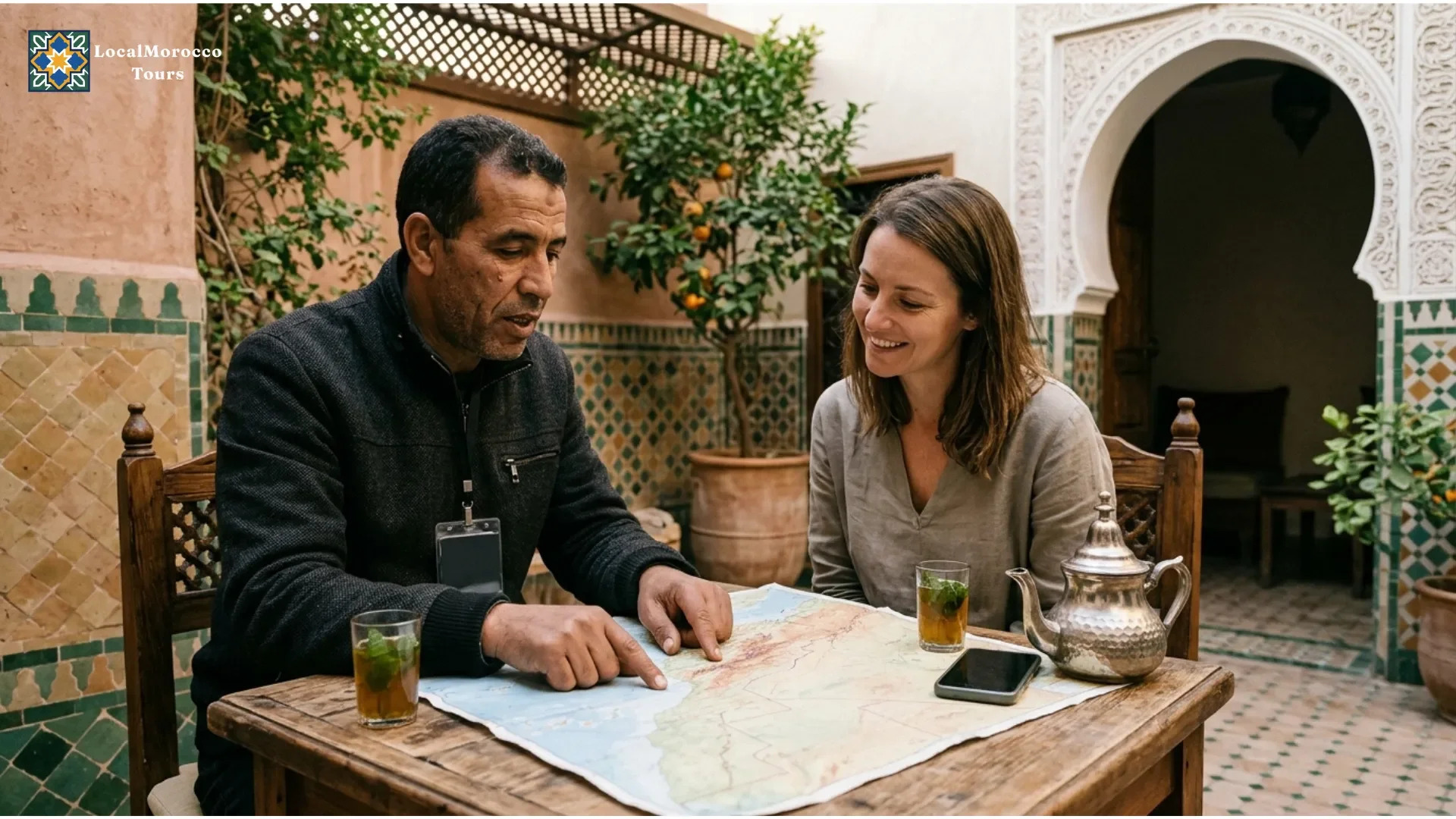
Ask an AI assistant to plan ten days in Morocco and you will have a tidy itinerary in seconds. What it cannot reliably tell you is whether the company it mentions holds a licence, whether the drive times are realistic, or whether the glowing reviews are genuine.
That gap matters more each year. Morocco's Ministry of Tourism reported 19.8 million tourists in 2025, up 14% on 2024. Meanwhile, MMGY Travel Intelligence found that half of US leisure travellers have used AI tools to plan travel, and that 52% of British travellers now do. With more visitors and more AI-assisted planning, knowing how to check Morocco tour companies is now a basic part of preparing a trip.
How do you know if a Morocco tour company is legitimate?
Short answer: Ask for the company's registered name and licence details and check them against official sources where you can, ask to see your guide's official badge, compare reviews on at least two platforms, get the itinerary and inclusions in writing, and read the cancellation terms before you pay a deposit. Use AI to build a shortlist. Use primary sources to make the decision.
What does "licensed" mean for tour companies in Morocco?
A travel agency in Morocco is a regulated business. The Ministry of Tourism states that opening one depends on obtaining a travel agent licence, and it publishes directories of agencies approved under Law 11-16 on its website, mtaess.gov.ma. Those directories are divided into two groups: travel organiser-distributors (Organisateurs-Distributeurs de Voyages) and travel distributors (Distributeurs de Voyages).
Tourist guides fall under a separate law, Law 05-12 as amended, and the Ministry publishes a separate list of approved guides. A guide belongs on the guide list, so an independent guide may not appear among the agencies.
A directory entry is useful confirmation. A missing entry does not by itself mean a company is unlicensed, because trading names can differ from registered names and the pages show no update date.
Why an AI recommendation is not proof of quality
AI search answers often point to pages from the open web. Google explains that to be eligible as a link in AI Overviews or AI Mode, a page must be indexed and eligible to appear in Search with a snippet. Appearing in an AI answer tells you that a page can be found. It does not show whether the business behind it is licensed.
AI itineraries can also be wrong in ways that look convincing. When the marketing agency SEO Travel tested 100 ChatGPT itineraries in 2024, it found at least one error in 90% of them, including visits scheduled outside opening hours. That test used the older GPT-3.5 model, so treat it as a warning and not as today's error rate. The risk is still real: the OECD's AI Incidents Monitor, which tracks press reports, lists a case of travellers in Peru being sent to a "Sacred Canyon of Humantay" that does not exist.
A Moroccan example: the road to the Sahara
Distances are where a neat Morocco itinerary can fall apart. Marrakech to Merzouga is about 560 km and takes 8 to 9 hours of driving over the Tizi n'Tichka pass, before you add a single stop. Zagora is closer at roughly 360 km, but the dunes are lower and more scattered than Erg Chebbi's.
So if an itinerary promises Ait Ben Haddou, Todra Gorge and a Merzouga sunset in one day from Marrakech, question it, whether it came from a chatbot or a sales page. Add up the driving hours for each day yourself. A more realistic plan looks like this 3-day desert tour from Marrakech to Merzouga or, if you are short on time, a 2-day Zagora desert tour.
Timing can change a plan as much as distance does. Check any desert itinerary against this site's guide to the best time to visit the Sahara, and use its Sahara packing list when you ask what the camp provides. Travelling in December? Compare any offer with this guide to Christmas in Morocco, which covers the weather and where to go.
The same check applies in the cities. AI-generated itineraries can recommend restaurants that have closed, so compare them with a local's food map of Marrakech. The same questions apply to activities in Marrakech: whether you choose a food tour, a half-day medina walk or a cooking class, ask who leads it, how long it lasts and what is included. For the north, set any packed schedule beside this slow-travel guide to Chefchaouen in a day, or compare it with a day trip from Fes to Chefchaouen.
A six-step check before you book
- Find the registered name. Ask for the company's legal name, because it can differ from the brand on the website, then search the Ministry's agency directory, which lists name, city and address. If you cannot find it there, ask the company for its licence details.
- Check the guide. The Ministry's guide list shows category and name only, with no licence numbers, so a name match is only a starting point. For guides in medina quarters, the UK government advises making sure they have an official badge and permission from the local authority, and warns that it is common for people posing as official guides to harass tourists. On this site, for example, Mohamed Chajia's profile publishes a licence number, and a guide of that name appears on the Ministry's list. Ask any guide to show the badge.
- Compare reviews across platforms. Tripadvisor says travellers shared 31.1 million reviews in 2024 and that it safeguarded them from 2.7 million fraudulent reviews that year. Favour reviews that name a guide, a route or a problem and how it was handled.
- Get the itinerary in writing. It should state daily driving time, the type of accommodation, whether the vehicle is private, and what is included. As this site's desert tour price guide notes, the gap between "all meals" and "half board" is where surprise costs hide. The same applies to a personalised tour built around your dates.
- Read the payment terms first. This company's terms ask for a deposit of usually 20 to 30% and set out what happens to it by notice period: refunded minus bank fees beyond 30 days, half refunded between 15 and 30 days, and non-refundable under 15. Those terms are one operator's policy and not a legal standard, but that level of detail is what to expect.
- Ask a specific question. When you request a quote from any operator, ask where you sleep on night two, how long that day's drive is, and what happens if weather closes the pass. A good operator should be able to answer specifically.
Take extra care with higher-risk activities. The same UK advice says to book hot air balloon trips only through licensed tour operators and to hire a professional guide for hiking in the Atlas Mountains, which is relevant to Toubkal treks.
What should a trustworthy tour company website show?
This section comes from the other side of the screen. I am Rochdi Karouali, a guest contributor to this journal. I am a Moroccan full-stack development student and digital professional, and I work on web projects with CodeSommet, a digital agency based in Marrakech. In the interest of transparency, CodeSommet developed this Local Morocco Tours website and has worked on its SEO, so please read this section with that relationship in mind.
In my view, design tells you very little, because a polished website is now cheap and quick to produce. Stock photos, AI-written copy and badge images cost almost nothing to add. These signals are harder to fake:
- A clear identity: a business name and a physical address you can find on a map.
- Named people: guides with credentials you can question, instead of an anonymous "our team".
- Published terms: deposit, balance and cancellation rules that are readable before you enquire.
- Badges that link out: an award image should lead to the issuing platform's own page.
- Specific content: real distances, drive times and trade-offs, including reasons not to book something.
AI tools remain useful for comparing routes and drafting questions. Ask them to cite sources, open those sources, and treat anything without one as unconfirmed.
Key takeaways
- Being recommended by AI shows that a company can be found, not that it is licensed.
- Morocco's Ministry of Tourism publishes directories of approved travel agencies and guides.
- Add up daily driving hours, especially on routes to the Sahara.
- Read reviews on more than one platform and look for specific detail.
- Get inclusions and cancellation terms in writing before paying a deposit.
Frequently asked questions
How do I find a licensed tour company in Morocco?
Ask for the company's registered name and licence details in writing. Morocco's Ministry of Tourism publishes directories of approved travel agencies that can help you confirm them. A missing entry is not conclusive, because registered names can differ from trading names and the lists show no update date.
Are tour guides in Morocco regulated?
Yes. Law 05-12, as amended, sets the conditions for entering and practising the profession, and the Ministry of Tourism publishes a list of approved guides. For guides in medina quarters, the UK government advises checking for an official badge and permission from the local authority.
Can I trust ChatGPT to plan a Morocco itinerary?
Use it for ideas and first drafts. Check drive times, opening hours and every named business against an original source, because AI itineraries have been shown to include closed venues, impractical schedules and places that do not exist.
Is it better to book a Morocco tour directly with a local company?
Booking directly lets you question the people running your trip and can avoid a reseller's margin. An agency in your home country may come with consumer protections under that country's rules, so check what applies. Either way, find out who actually operates the tour on the ground.
Are online reviews of Morocco tour companies reliable?
They are useful but imperfect. Tripadvisor says it safeguarded travellers from 2.7 million fraudulent reviews in 2024, so compare several platforms and give more weight to dated, detailed reviews that mention guides, routes and how problems were resolved.
How many days do you need for a Sahara tour from Marrakech?
This site's route guides recommend three days for Merzouga, given the 8 to 9 hour drive each way, and treat two days as the minimum for Zagora. See this site's guide on how many days to spend in Morocco for full-trip planning.